
Content design case study

Brex doesn’t just offer businesses banking and credit card accounts, it also has a bunch of fintech products, like automated expense management and travel booking. That means Brex needs to send a lot of email comms to its customers. Imagine if something critical happened with your bank account, and no one reached out tell you – yikes!
But Brex has a really small content team, so most of those emails end up getting written by product managers (PMs). When a PM notices a communication gap, they type up an email and we are good to go.
…or so we thought.
The problems
Sound the alarm! The CEO says our comms suck!
After getting negative feedback about our emails, Brex’s CEO started laying down goals to get our emails back on track.
Problem 1: We send too many emails
This was the primary piece of feedback our CEO received. According to our numbers, the average Brex admin received 30 emails per month, with some getting over 200! Holy moly.
Goal 1: Eliminate unnecessary emails to reduce volume
Problem 2: Emails are inconsistent and confusing
Because the emails were being created by PMs from different areas of the business, over time they had adopted different visual and content formats. While these formats may have made the sense for each PM’s specific topic, it does make viewing them in succession feel disjointed.
Also, a lot of these emails didn’t always have a clear purpose to them. Some lacked clarity around basic customer question, like Why is this important? or What should I do about this?
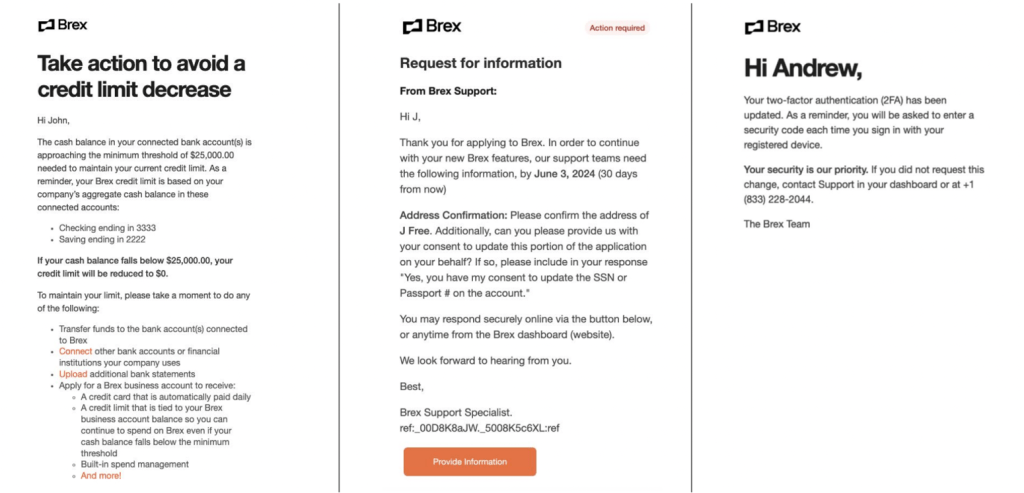
The examples below show just how inconsistent Brex emails can be. There’s a mix of font sizes, formats, and CTA styles, but I think my favourite is the subject line that just says: Hi Andrew.
Goal 2: Improve email quality and consistency to increase engagement (open and click rates)
PM’s initial approach
When the CEO’s eyes are on it, a project tends to kick off fast. Initially led by a PM, I and a few other team members quickly got swept up in the fray:
- Product manager
- Product designer
- Brand designer
- Content designer (me)
The PM’s approach was simple: we’ll have each PM audit all of the email comms in their business area, and then sort them into categories based on their contents and purpose.
These are the buckets our PM chose:
1. Action required (critical)
2. Action required (non-critical)
3. Must-know information
X. Should be eliminated
This was when I was pulled onto the team, to help facilitate this audit and make sure PMs were sorting their emails into the appropriate categories.
It sounded simple enough…
Audit results
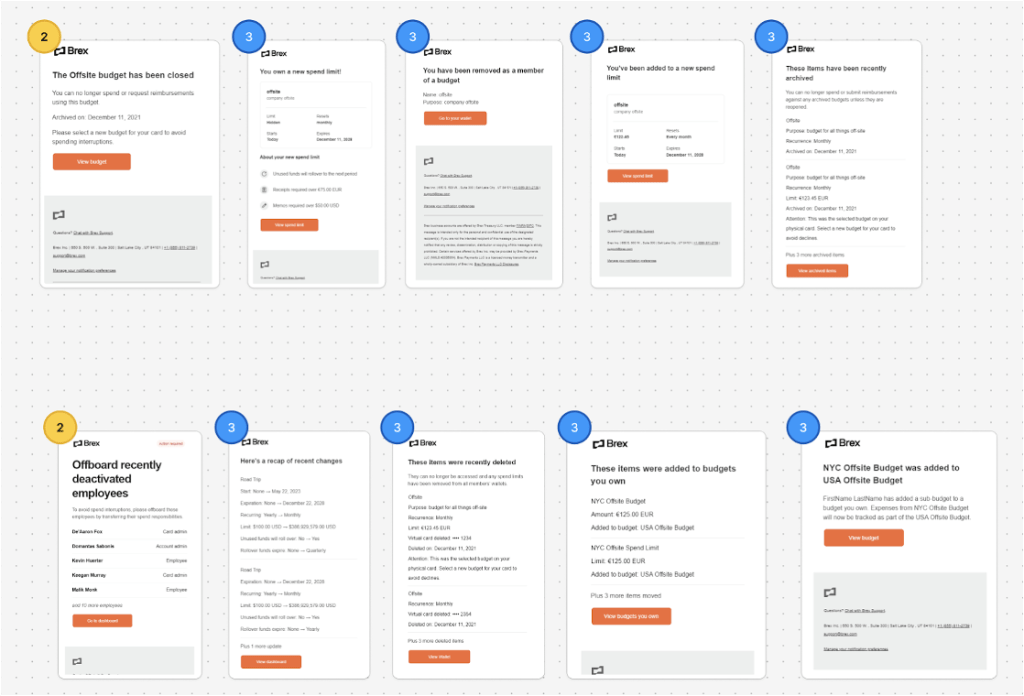
But as I facilitated and observed the audit, I noticed something strange. The PMs were assigning almost no emails an X – to be eliminated. It turned out, all of our emails were absolutely necessary!
My approach
It was clear to me that this audit idea wasn’t working as intended. That’s when I started asking the team some tough questions:
- Why are we asking PMs to eliminate the very emails they created? Of course they think they are necessary!
- We asked them to sort them into categories, but we never took the time to define those categories. What makes something critical? What makes something must-know? Everyone is going to interpret these differently.
- While observing the audit, I noticed that PMs were thinking about what makes an email valuable from a Brex perspective, not a customer perspective
I realized that the only thing that would help us cut emails was to really understand what makes an email valuable to a customer. So I took the reins and got to work.
A value-based framework
To do this, I got to work creating my own collection of categories – this time, clearly defining what attributes make an email valuable to a Brex customer.
Under my framework, an email is only valuable enough to send if it meets one of these criteria:
Action required (critical)
Prompts an action item that if not actioned within a specific timeframe, will prevent you from using Brex.
e.g. Dormant account closure
Opportunities
Presents an opportunity that is measurable, actionable, and significant.
e.g. $100 in cash back rewards available
Long-term info
Shares information that is relevant in the long-term (1+ month) and/or relevant outside of the Brex context.
e.g. Confirmation of travel booking
This meant that in stead of relying on PMs to make subjective decisions about value, we now had an objective framework to serve as a litmus test.
But I knew I wouldn’t get it right on the first try. That’s why I established the most important principle of all:
If we want to send an email that falls outside of these definitions, we must be able to clearly articulate its customer value AND why it must be sent as an email.
I really emphasized this to the team, because clear articulations were critical to understand where the gaps in the framework were. By asking ourselves these questions, we will be able to discover and quantify more categories of customer value, and further scale the framework.
Question to ask:
- Does this email fall into an existing bucket? Which one?
- If not, do we think it should be sent anyway?
- If so, what specific value does it bring to our customer that falls outside of the buckets?
- And why does that value need to be provided via emails vs in product or some other channel?
Iterating the framework
Armed with a framework that emphasized value and the importance of articulating it, our small team began to re-audit the emails. To bring my stakeholders along for the journey, I had to play devil’s advocate a bit to make sure we were holding ourselves to a high standard of value, and making decisions based on a solid rationale.
This meant I was constantly questioning the team (even if I agreed with them):
- Sure, this email presents an opportunity, but is it significant enough?
- Sure, this email has an action item, but if there’s no time frame, why does it matter if the task gets done?
- Sure, this information may meet our standards, but why must it be an email? Why is it worth potentially disrupting a customer’s day?
This wasn’t about my opinion on the emails – it was about making sure the framework was doing its job to set the bar higher.
This process was often tedious and frustrating, but it also led to some really important conversations and new understandings of customer value! That value took the form of two additional categories added to the framework.
Action required
(non-critical)
Prompts an action item that helps the customer to control spend or facilitate user-to user communication.
e.g. Approve this employee expense
Security and compliance
Any messages that we are legally or morally obligated to send to customers for legal or security reasons.
e.g. 2FA setup
How these categories were added:
- Action required (non-critical):
We ended up adding this bucket back as there were many action items that might not be critical, but allow the control of spend, which is at the core of Brex’s fintech products. We agreed that this meant these actions are inherently valuable to our customer. - Security and compliance:
As a financial institution, Brex is legally required to send certain emails that may not have obvious customer value (e.g. we updated something minor in our terms of service). But our obligations don’t end where the law does – we also have a moral duty to inform our customers about certain security topics, even if we are not required to do so.
User research
While we reaudited, we also ran a number of user surveys to better understand how our customers felt about the emails they receive. These led us to even more ideas for how to cut email volume while improving quality and consistency.
Email digests
We learned that most customers wanted a less frequent cadence for certain types of emails. Since the categories in the value framework already aligned to different levels of urgency, it was easy to match an appropriate email cadence to each bucket.
| Action required (critical) | Action required (not-critical) | Opportunities | Long-term info | Legal and security | |
|---|---|---|---|---|---|
| Timing | Always sent immediately | Sent 2 hours after trigger, unless another trigger of the same type occurs within that period | Sent 24 hours after trigger if not yet engaged in product | Sent 2 hours after trigger, unless another trigger of the same type occurs within that period | Always sent immediately |
| Digest | n/a – never digested | Sent 24 hours after first trigger, digesting all triggers within that period | n/a – never digested | Sent 24 hours after first trigger, digesting all triggers within that period | n/a – never digested |
Clear and consistent email templates
The surveys also helped us identify what visual and content elements resonated with customers to create email templates. These templates have both visual and content guidelines to keep emails visually consistent, while being written to bring clarity to the email’s value every time.
Example: Content guidelines for Action Required (Critical)
- Tone: reassuring
- Subject line:
- If timeline less than 24 hours:
Urgent: [ state action required ] - If timeline more than 24 hours:
Important: [ state action required ] - e.g. Important: Update your financial information
- If timeline less than 24 hours:
- Header: Repeat the subject line without Urgent/Important tag
- Greeting: Hi [ first name ],
- Context: set context in 1-3 sentences
- Why we are sending this
- The timeline/due date
- Consequence if not actioned
- CTA: [ verb + subject ]
- Use single CTA button
- 2nd tense
- Keep as short as possible
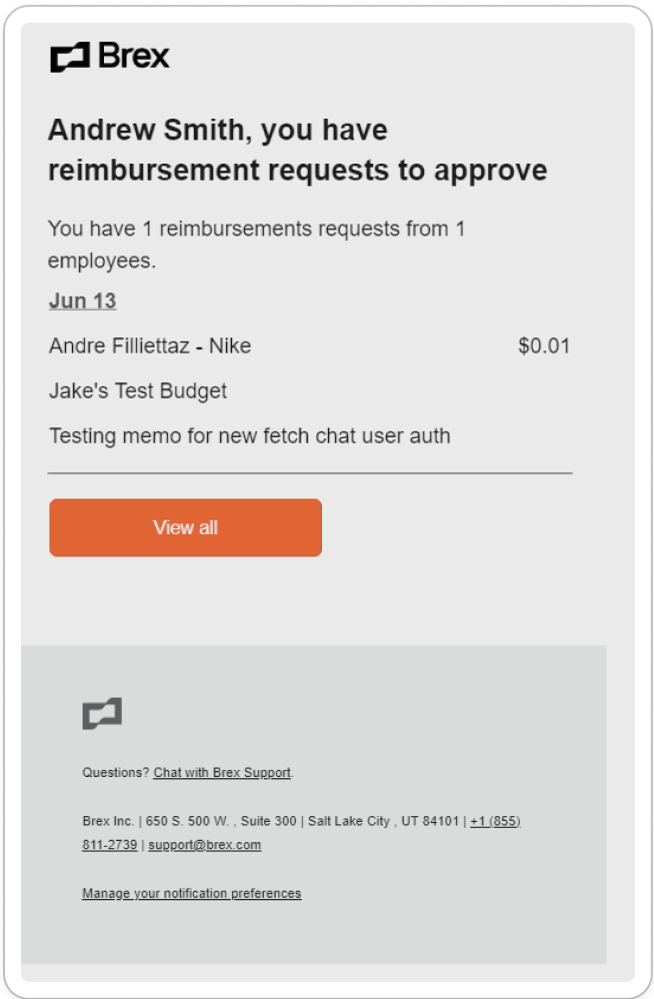
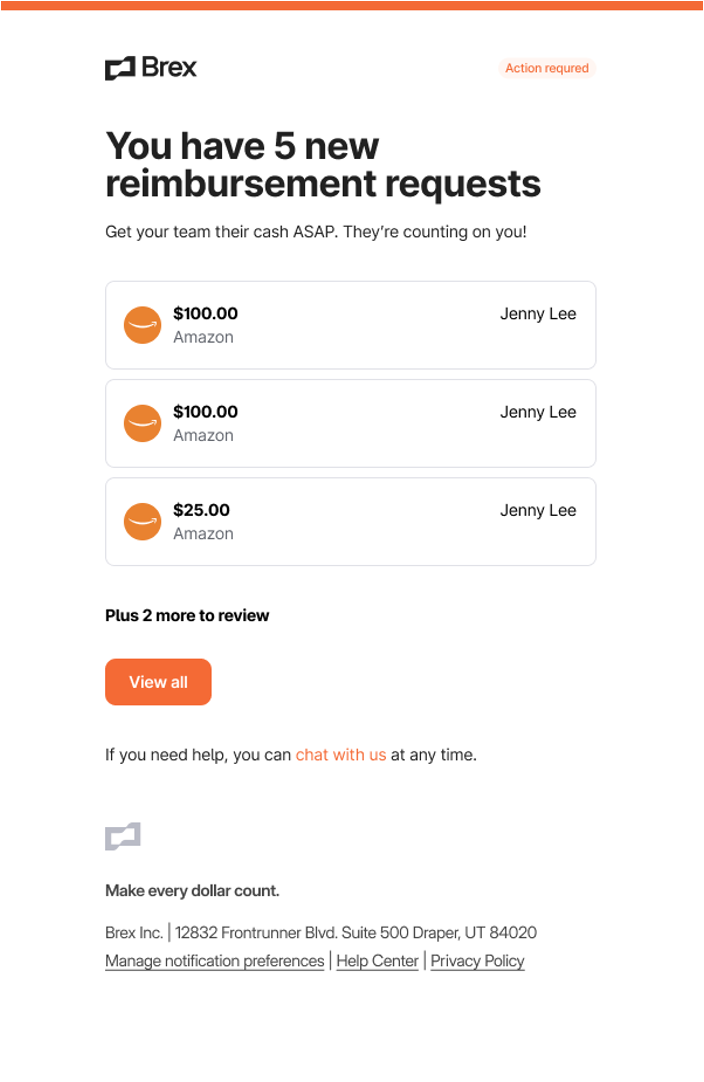
Before and after: Visual design for Action Required (Non-Critical)
The results
So did we meet our initial goals? I’d say YES.
Goal 1:
Reduce Emails
Emails eliminated from repository:
~125 of 500
25% ↓
Goal 2:
Improve Opens
Overall open rate increased from:
43.16 to 54.86%
12% ↑
Goal 3:
Improve CTR
Overall click rate increased from:
3.12 to 7.52%
2.5X ↑
Regardless of numbers, my net-new framework not only ensures we’re meeting a higher bar, but that bar is based on value to the customer, not what’s most convenient for Brex. And isn’t that what it’s all about?
Want to see more?
Check out my other case studies or learn a little more about me.
 Maria the Copy Cat